Data Centers
Georgia is building over $60 billion in data center infrastructure. Every facility requires miles of mechanical piping for chilled water systems, condenser water loops, and cooling tower circuits. FTS supplies the butterfly valves, ball valves, check valves, actuators, and instrumentation that keep these critical systems running. With 25+ years of industrial piping experience and 34+ manufacturer partners, we deliver the right valve solution for every data center application in the state.
Common Valve Applications in Data Centers and How FTS Approaches Them
Strip away the servers and a data center is a heat-moving machine, and every gallon of water it moves passes through valves. The AI buildout has turned a quiet corner of the HVAC world into one of the largest valve markets in the country, and most of it is being built within a few hours of our shop.

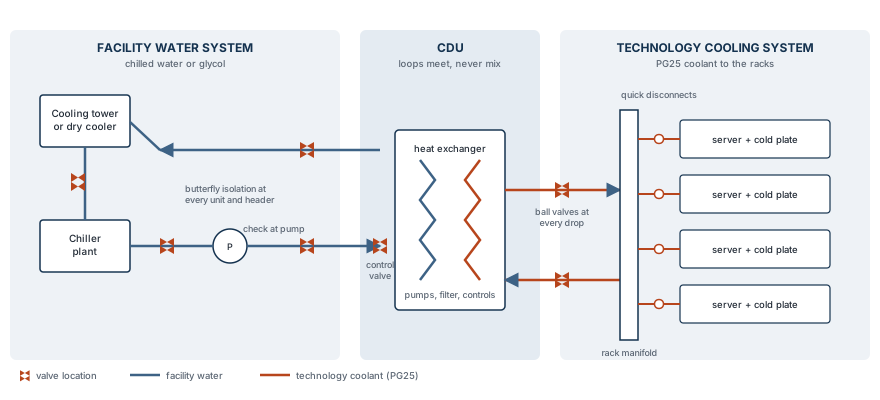
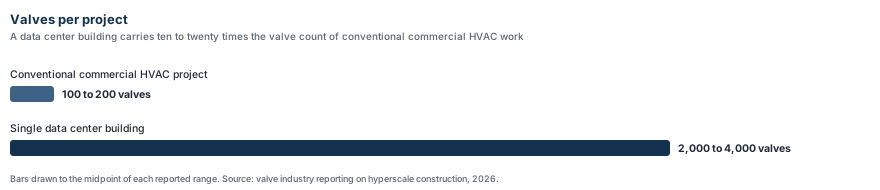
A modern data center runs two separate water worlds. The facility water system is the plant side: chillers, cooling towers or dry coolers, big pumps, and large-bore headers moving chilled water or glycol. The technology cooling system is the IT side: coolant distribution units, rack manifolds, and cold plates bolted directly to the processors, usually running a 25 percent propylene glycol mix. The two sides meet at a heat exchanger and never mix. Each side has its own valve population, and both populations are enormous. Industry reporting puts a single data center building at 2,000 to 4,000 valves, ten to twenty times what a conventional commercial HVAC project carries. One major valve manufacturer describes single orders of five hundred 20 inch butterfly valves for one campus.
The chilled water plant: butterfly country
The plant side belongs to the butterfly valve. Chiller isolation, pump isolation, header sectionalizing, and tower riser duty are all quarter-turn resilient-seated butterfly work: light, compact, cheap per inch of bore, and easy to automate. Where tighter shutoff or higher differential pressure shows up, the spec steps up to a double-offset high-performance valve. Every pump discharge carries a check valve, and the modern preference is a spring-assisted silent check or dual-plate wafer check that closes before reverse flow builds, because water hammer has no place in a building full of electronics.
This is our bread and butter. Resilient-seated and high-performance butterfly valves, dual-plate and silent checks, and basket strainers are the core of what we have shipped for decades, and we ship them as finished packages: valve, actuator, feedback, mounted and tested, one part number. More than half of everything that leaves our dock is a complete automated assembly.
Heat rejection and the glycol trap
Warm-water cooling is pushing heat rejection toward dry coolers and closed glycol loops, and glycol changes the metallurgy. Standard brass and bronze trim corrodes in glycol service, and open tower water brings its own problems of scale, solids, and biology. The correct answer is stainless trim and seat materials selected for the mix, specified up front rather than discovered at the first rebuild.
We ask what is in the pipe before we quote. Stainless ball and butterfly lines with glycol-compatible seats are standard catalog items for us, not specials, and we will flag a brass-in-glycol spec problem when we see one.
Air-side coil control
Even a liquid-cooled AI hall still air-cools 20 to 30 percent of its load, so hundreds of CRAH units each need a modulating coil valve. The market has moved from 3-way valves to 2-way, and increasingly to pressure-independent control valves that hold design flow to each coil as system pressure swings. The result is stable delta-T across the plant and no proportional balancing act at commissioning. This is a high-count, repeat-SKU package: control valve, isolation balls, strainer, and gauge trim at every unit.
Repeat-SKU packages are what a valve automation shop is for. We hold the configuration, build every unit set identical, and label them so the fourth hundred looks exactly like the first.
Direct-to-chip: the small-valve explosion
The technology loop is where valve counts go vertical. A single high-density AI rack moves more than 180 gallons per minute of coolant through its manifold. Every rack drop wants isolation on supply and return so one server can come out without draining its neighbors. Every CDU carries its own isolation, control, check, relief, fill, and drain valves. Designs with redundant isolation run a dozen or more small ball valves per rack, multiplied across thousands of racks. The service is undemanding on pressure and brutal on everything else: wetted materials are restricted to copper alloys and stainless because rust and debris clog cold-plate channels finer than a millimeter, and a single seep event happens directly above live GPUs. Compact, bubble-tight, full-port ball valves in clean materials are the standard answer.
We supply exactly this class of valve today, from economy two-piece patterns to high-performance and fire-safe lines, in stainless with clean seat materials, direct-mounted on ISO 5211 pads so there is no bracket slop and no field assembly. If a spec names a brand we carry, including Bonomi, we buy it factory-direct. If the brand cannot deliver, we put an equivalent on the table with the cross-reference to prove it, because in this market the second source is not a luxury. It is the schedule insurance.
The real problem is the calendar
Talk to anyone buying valves for a data center and the conversation is not about technology. It is about lead time. Buildings that once took years are being compressed into months, contractors report material lead times as a top project risk, and commodity valves are the item nobody wants to be the reason a nine-figure hall slips. The procurement pattern has shifted too: more and more valves are bought not at the jobsite but by skid fabricators and CDU builders assembling pump skids and cooling modules offsite. Those OEMs need the same valve, correct, tested, and on time, over and over.
Why this matters in Georgia, and why FTS
Metro Atlanta ended 2025 as the second largest data center market in the United States by industry measures, with roughly two gigawatts under construction and utility commitments stretching years out. The cooling systems for all of it are designed around the valve families FTS has stocked, automated, and bench-tested for decades, including Bray, one of the most visible valve brands in data center cooling, and deep-inventory ball valve lines built for exactly this second-source moment. We buy direct from most valve manufacturers in the country, we ship assemblies as one tested part number, and we try to turn every quote in 24 hours. If you are building, skidding, or maintaining data center cooling in the Southeast, we are already in your backyard.
Applications
Products for Data Centers
Maxseal
Crane Fluid Systems
Flowserve
Flo-Tite
OMC Americas
V-Tork
Winters Instruments
WIKA
Need Valves for Data Centers?
FTS has been supplying Georgia's data centers industry for over 25 years. Tell us about your application and we'll recommend the right products.
Request a Quote